
Starting your trading journey without a solid strategy is like driving blindfolded – you might get lucky for a while, but eventually, you’ll crash. Most new traders jump into the markets with nothing but hope and a few YouTube videos under their belt, only to watch their accounts evaporate faster than morning dew.
The difference between successful traders and those who blow up their accounts isn’t luck or some secret formula. It’s having a well-thought-out trading strategy that matches their personality, risk tolerance, and lifestyle. This guide will walk you through everything you need to know about selecting your first trading strategy, helping you build a foundation for long-term success in the financial markets.
Understanding Trading Strategies Fundamentals

A trading strategy is essentially your roadmap for making buy and sell decisions in the financial markets. It’s a set of predetermined rules that tell you when to enter trades, when to exit, how much to risk, and which assets to focus on. Think of it as your trading blueprint – without it, you’re just gambling with expensive consequences.
New traders often underestimate the importance of having a structured approach. They see successful traders making what looks like spontaneous decisions and assume trading is all about gut feelings and quick reactions. This couldn’t be further from the truth. Professional traders spend years developing and refining their strategies, backtesting them against historical data, and continuously adapting to market conditions.
The biggest misconception beginners have is that a good trading strategy guarantees profits. No strategy wins 100% of the time – even the most successful hedge funds lose money on individual trades. What matters is having positive expectancy over time, meaning your winners outweigh your losers when you look at the big picture. Your strategy should be designed to keep you in the game long enough for probability to work in your favor.
Types of Trading Strategies for Beginners
Day trading involves opening and closing positions within the same trading session, never holding overnight. This approach requires intense focus, quick decision-making, and the ability to handle stress. While day trading can be profitable, it demands significant time commitment and psychological resilience that many beginners lack.
Swing trading offers a middle ground, holding positions for several days to weeks. This style works well for people with day jobs since you don’t need to monitor charts constantly. Swing traders focus on capturing medium-term price movements, riding trends while they develop and exiting before major reversals occur.
Long-term investing strategies involve holding positions for months or years, focusing on fundamental analysis rather than short-term price movements. This approach requires patience but typically involves less stress and lower transaction costs. Position traders often combine technical analysis with fundamental research to identify undervalued assets with strong growth potential.
Here are the most beginner-friendly strategy types to consider:
• Buy and Hold – Purchase quality assets and hold long-term • Dollar-Cost Averaging – Regular purchases regardless of price • Trend Following – Trade in the direction of established trends • Support and Resistance – Trade bounces off key price levels • Moving Average Crossovers – Enter when fast MA crosses slow MA • Breakout Trading – Trade when price breaks key levels • Mean Reversion – Trade when prices deviate from average
Key Factors to Consider When Choosing Your Strategy
Your risk tolerance should be the primary driver of strategy selection. Conservative investors might prefer buy-and-hold approaches with blue-chip stocks, while aggressive traders might gravitate toward day trading volatile assets. Be honest about your emotional capacity – can you handle watching your account swing wildly, or do you need steadier, more predictable returns?
Time commitment is another crucial factor that many beginners overlook. Day trading requires your full attention during market hours, while swing trading might need just a few hours of analysis per week. Consider your current schedule, family obligations, and energy levels when choosing your approach. There’s no point selecting a strategy you can’t properly execute.
Essential criteria for evaluating potential strategies:
- Capital Requirements – How much money do you need to start?
- Time Commitment – How many hours per day/week required?
- Risk Level – What’s the maximum drawdown you can handle?
- Learning Curve – How long to become proficient?
- Market Conditions – Does it work in all market environments?
- Transaction Costs – How do fees impact profitability?
- Psychological Demands – Can you handle the stress level?
- Technology Needs – What tools and platforms are required?
Popular Beginner Trading Strategies Explained
The buy and hold strategy remains one of the most effective approaches for beginners. This method involves purchasing quality stocks or ETFs and holding them for extended periods, typically years or decades. Warren Buffett built his fortune using this approach, focusing on companies with strong fundamentals and competitive advantages. The key is selecting solid businesses trading at reasonable prices and having the discipline to ignore short-term market noise.
Dollar-cost averaging takes the guesswork out of timing the market by investing fixed amounts at regular intervals regardless of price. This approach naturally buys more shares when prices are low and fewer when prices are high, potentially reducing your average cost basis over time. It’s particularly effective in volatile markets and removes the emotional component of trying to time perfect entries.
Trend following strategies capitalize on the momentum principle that prices in motion tend to stay in motion. These approaches use technical indicators to identify established trends and enter positions in the same direction. The key is distinguishing between genuine trends and temporary price fluctuations, which requires patience and proper risk management to avoid getting whipsawed by false signals.
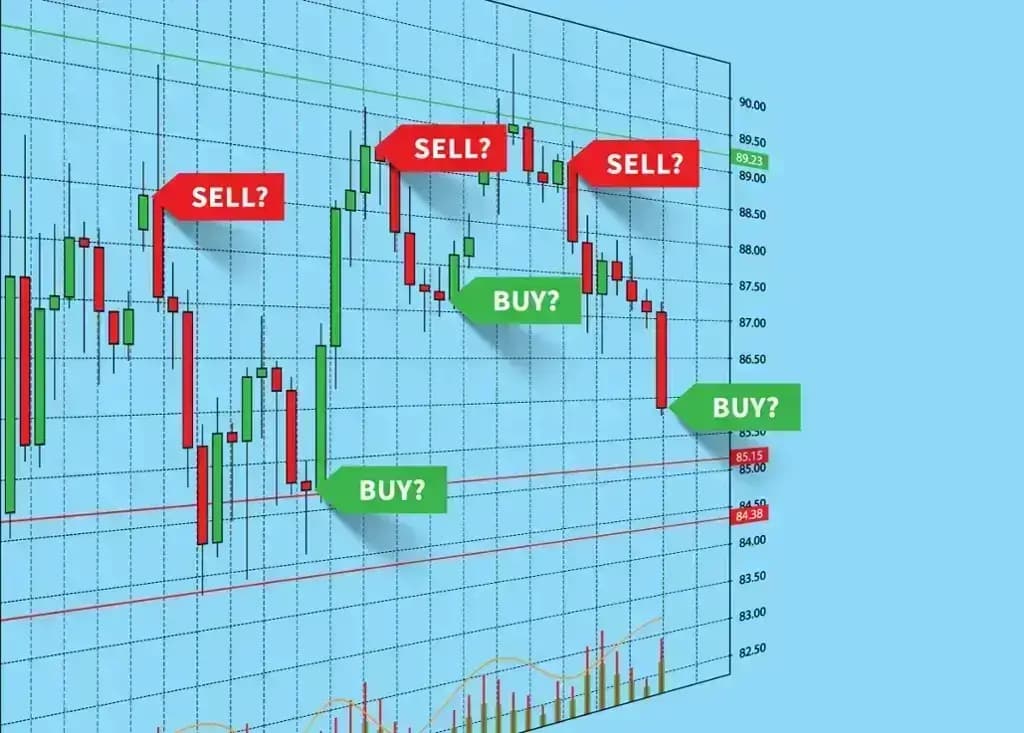
Support and resistance trading focuses on key price levels where assets have historically bounced or reversed. Support levels act as floors where buying interest emerges, while resistance levels serve as ceilings where selling pressure increases. This strategy works because these levels represent psychological barriers where traders and investors make predictable decisions based on past price action.
Moving average strategies use these smoothed price indicators to identify trend direction and potential entry points. Common approaches include trading crossovers between fast and slow moving averages or using price action relative to a single moving average. These strategies work well because moving averages filter out market noise while highlighting underlying trends that drive longer-term price movements.
Risk Management in Strategy Selection
Position sizing determines how much of your account you risk on each trade, and it’s arguably more important than your entry and exit points. Professional traders typically risk no more than 1-2% of their account on any single trade, ensuring that even a string of losses won’t devastate their capital. New traders often risk too much per trade, leading to emotional decision-making and account blowouts.
Stop-loss orders are your insurance policy against catastrophic losses, automatically closing positions when they move against you by a predetermined amount. The key is setting stops at logical levels based on technical analysis rather than arbitrary percentages. Your stop-loss should be far enough away to avoid getting stopped out by normal market fluctuations but close enough to limit damage if you’re wrong about trade direction.
Critical risk management rules every beginner should follow:
• Never risk more than 2% per trade – Preserve capital for future opportunities • Use proper position sizing – Calculate shares based on risk, not dollar amount • Set stop-losses before entering – Remove emotion from exit decisions • Diversify across assets – Don’t put all eggs in one basket • Keep detailed records – Track what works and what doesn’t • Plan for worst-case scenarios – Know maximum acceptable losses
Testing and Practicing Your Chosen Strategy
Paper trading allows you to test strategies with virtual money before risking real capital. Most brokers offer demo accounts that mirror live market conditions without financial consequences. Spend at least three months paper trading any new strategy, tracking your performance and identifying areas for improvement. This practice phase helps you understand how the strategy performs in different market conditions and builds confidence in your approach.
Steps for properly testing your strategy before going live:
- Set up demo account with realistic starting capital
- Trade for minimum 3 months to see various market conditions
- Keep detailed trade journal documenting entry/exit reasoning
- Calculate key metrics like win rate, average win/loss, maximum drawdown
- Identify weaknesses and refine strategy rules
- Practice emotional discipline even with fake money
- Start small when transitioning to live trading
Common Mistakes to Avoid
Strategy hopping is the kiss of death for beginning traders. When a strategy hits a rough patch (which all strategies do), inexperienced traders panic and switch to something else, never giving any approach enough time to prove itself. Professional traders understand that losses are part of the game and stick with proven strategies through temporary drawdowns.
Critical mistakes that destroy beginner trading accounts:
• Changing strategies after losses – Never give approaches time to work • Ignoring risk management – Risking too much per trade • Overcomplicating approaches – Using too many indicators or rules • Emotional decision making – Letting fear and greed drive choices • Insufficient testing – Going live without proper paper trading • Unrealistic expectations – Expecting consistent profits immediately
Building Your Trading Education Foundation
Continuous learning separates successful traders from those who eventually give up. Markets evolve constantly, and strategies that worked yesterday might not work tomorrow. Dedicate time each week to studying charts, reading market analysis, and learning from experienced traders. The most successful traders treat their craft like a profession, constantly working to improve their skills and adapt to changing conditions.
Quality educational resources make a significant difference in your development speed. Look for courses that emphasize practical application over theoretical concepts, with real-world examples and case studies. Many successful traders credit structured education programs with accelerating their learning curve and helping them avoid costly mistakes that self-taught traders often make.
Finding mentors or joining trading communities provides invaluable support during your learning journey. Experienced traders can share insights that take years to discover independently, helping you navigate common pitfalls and psychological challenges. The key is finding communities focused on education rather than get-rich-quick schemes or hot stock tips.
Final Thoughts
Choosing your first trading strategy isn’t about finding the “perfect” system – it’s about finding an approach that matches your personality, schedule, and risk tolerance while giving you a mathematical edge over time. The best strategy is the one you can execute consistently without letting emotions derail your decisions.
Remember that becoming a profitable trader is a marathon, not a sprint. Focus on developing good habits, managing risk properly, and continuously learning from both successes and failures. With patience, discipline, and the right educational foundation, you can build the skills necessary to succeed in today’s competitive financial markets.